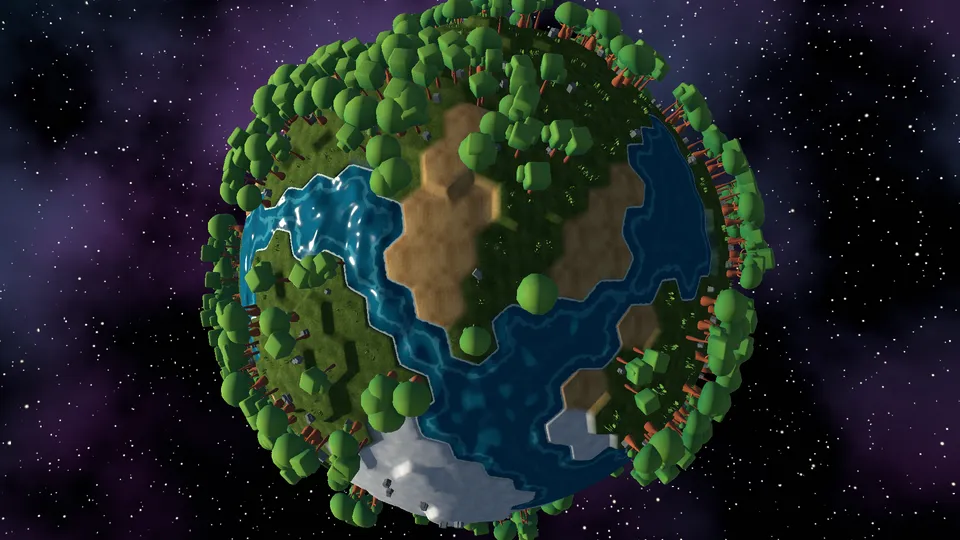
The goal
I’ve always been drawn to the look of games with tiny planets, such as The Universim, Dyson Sphere Program, and Before We Leave.
These worlds feel cozy and seem like great places for different gameplay ideas to flourish. As a player, I want to land on that little planet and explore every corner. With Mundo, I set out to explore the math behind these worlds and experiment with gameplay ideas.
What works so far?
- Globe geometry: Hexagon/pentagon grids on a spherical world.
- Orbital camera: Able to rotate around the world, but always keeping north up to avoid getting lost.
- Camera zoom: Zoom in and out, with slight camera angle variations to keep the horizon in sight.
- Water: Water mesh with its shader.
- Terrain shading: Each cell has a terrain type that blends with its neighbors.
- Terrain regions: Each region has randomized, configurable props.
- Terrain height: Each cell receives a height based on a perlin noise source.
- Character Controller: Third person character controller and over the shoulder camera.
What’s next?
- More map configurations.
- Different gameplay tests, city builders, RTS, action.
Use of AI
“AI Lab” projects are mainly coded using agentic AI. My purpose is to learn a subject as fast as possible. I guide development with incremental prompts, read the code to understand it, and ask questions about the underlying theory. I believe this is a great way of discovering my unknown unknowns faster.
Assets Credits
- All 3D Model assets are part of Kay Lousberg collection.
Development notes
The experiments and decisions behind Mundo.
The shape of Mundo
Exploring tiny worlds representation, comparing a cube-sphere with hexagons and pentagons, and how they relate to a logical gameplay grid.
Read development note